After the impact of the pandemic on students, it is more important than ever for parents to find ways to support education.
According to a study by The Fatherhood Institute, during Spring 2020 (during lockdown) 78% of fathers spent more time with their children and 68% spent more time than usual on home-schooling and helping with homework.
Research* also shows that involved fathers can significantly improve the progress of their child’s education. To help give your child the best start in life, Ian Thompson, a father of two and a Maths tutor at Tutorful, the experts in online tutoring, gives his top tips of how dads can support their child’s education:
New research reveals that 78% of secondary school parents feel the pandemic harmed their children's education. With parents believing that their child is a whole school year behind (9.5 months). Online tutoring platforms like Tutorful has over 11,000 tutors to choose from. Parents can choose one to help gain back lost time, and support education.
The benefits of using online tutors include:
You have to find the tutor that suits your child best. With relevant experience and the personality that works with them. Sometimes when I teach we spend the first lesson just getting to know a little bit about their school experience. However, in many instances, just a few lessons can give a young person back their confidence. For me, as a tutor, that is a life changing event.
Asking your child to teach you about a subject can help you test them in a more creative way. They can choose a topic that they have recently learned about in school. Any questions they are not sure about you can find out together. Get them to help you search online or by reading a relevant book. Allow your child to have fun as the role of the teacher. You could get them a whiteboard and pens. Let them set the rules - make it fun!

Discussing classwork outside of the school environment will immediately give you an informal insight into what they are learning. The amount of homework set and what subjects they find difficult. Give your son or daughter plenty of time to show you what they can do. Remember, things have changed a lot since we went to school and kids are taught in different ways not! So don't be too quick to say that's not the right method. This can also be a great tool for revision. Teaching someone else will help them remember everything they've learnt, and can work better than re-reading notes for some kids.
An adventurous way to learn is through educational games that can help children with non-cognitive and cognitive skills. Whether it’s an entertainment video game, or games that teach skills like coding. Game based learning often motivates children as there is a competitive element.They can help with grammar, new concepts and building knowledge.
Take your child to the theatre, art exhibitions or workshops to teach them that learning is not limited to the classroom. There are lots of free events that you can find on platforms like EventBrite. For example, if they are a history buff, take them to a museum or archaeological site. Exposing children to activities outside of their school curriculum can help them discover passions and talents that they might never have known otherwise. The trips contribute to a well-rounded educational experience. They encourage children to use their imagination and help them express their feelings and opinions with you as their sounding board.
Ahead of exams - sitting in a bedroom, surrounded by the same four walls, isn’t always the best place to revise. The good news is that revision doesn't have to be boring! And bad days do not have to correlate with GCSE revision.
Why not offer to take your child to a cool cafe or coffee house? Grab a hot drink, log into the wifi and start studying! Something as simple as a change of setting can be great for the brain. A change of setting can be great for the brain. Often it motivates us to explore new ways to achieve our goals. Letting your teen choose where to go will be empowering. Which will help them to feel like they’re completely in control of their success.
The chances are, they’ll also see adults working with their laptops too. Sending a hugely important message that hard work is something that we choose to do, to achieve success throughout our lives.
Not a fan of a coffee shop? If the weather is good, why not try a park? Or a finding a quiet, pretty spot in the country side? Fresh air, and a change of scenery can be great for learning.
If your child has been working hard on a subject (even if they are struggling with it) make sure you acknowledge their efforts. Children, whatever their age, want to feel seen by their parents and acknowledgments show you care.
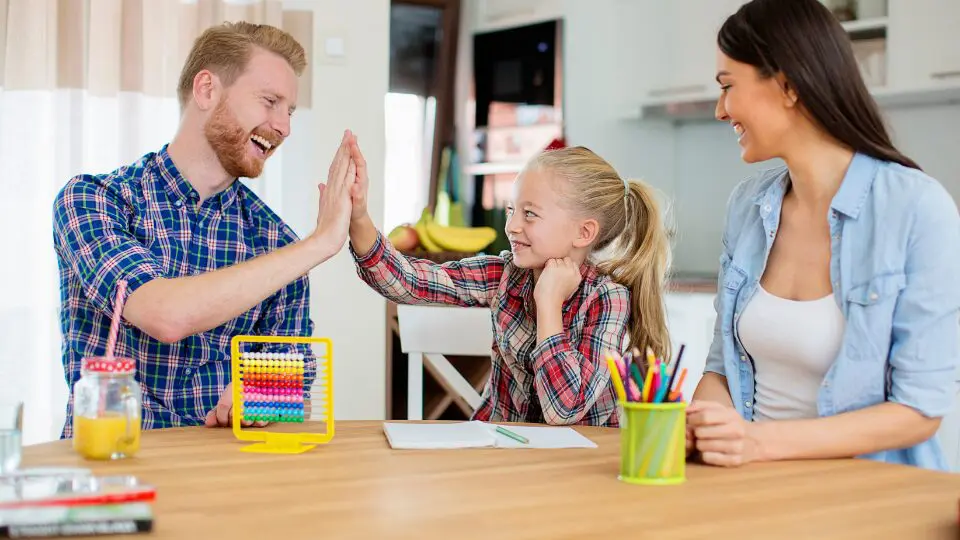
Although children need to pass exams to progress in education. Remind them that character traits like determination, resilience and perseverance aren't counted in tests! These are all signs of success that aren't measured by the exams they take. And will also help them longer term when they reach the workforce.
If you think your child needs positive reinforcement, a reward can be as simple as cooking their favourite dinner. Or watching a movie, allowing more screen time, or maybe a small token gift? But don't forget, simply saying words like "I'm proud of you" is a great reward for a child. And these can be morale boosters to help them stay positive.
There are certain life skills that can help your child develop that can be taught from an early age. From learning the basics of cooking e.g. how long to cook an egg and pasta; to gardening like growing your own food and herbs. Also teaching them about local wildlife or doing the laundry. And as they get older understanding the cost of living like a loaf of bread, milk, bills etc. This can help prepare children for when they move out or go to university. And it will help them feel better prepared to set them up for success.
I wasn't always a teacher and didn’t expect at 18 years old that one day I would become one! However, somebody in education gave me a chance and realised I had the Math knowledge and the ability. The only thing lacking was confidence.
I owe a huge thank you to my friend Paul. One day he gave me a whiteboard pen as I walked into a room. Then he said that he had an appointment to go to. He threw me in the deep-end, and left me in a room to teach 20+ students. The rest, as they say, is history.
It took me a while to find what I wanted to do, and be. But, I did and I love it. An important part of being a teacher, is remembering that not all children will learn at the same pace. Or in the same way. The most important way to support education, is to give your child space to shine.
Are you looking for more ways to support education? Or maybe you want to learn about Great Ways For Dads To Connect Through Educational Support? Maybe your little ones are transitioning to school or nursery and you're starting the formal education journey?
Whatever you're looking for, we have some really great information about education across the site. From more great blog posts, to brilliant Dad Chats about Education.
On the 25th of May 2020 George Floyd was killed by a police officer in broad daylight. Another senseless murder of a member of the black community, it sparked a chain of events that caused people to take notice. It caused people to think about the racism black people have suffered. It has added fuel to the Black Lives Matter movement and raised it's worldwide profile. Now more than ever it feels like there has been a shift in consciousness, like people both black and white people have had enough of the systemic racism that poisons our lives. This is why it is so important for us to talk to children about #Blacklivesmatter. If we are going to make things better it starts with educating both ourselves and our children.
In addition to writing this post I also spoke about this topic on the BBC Bitesized Primary Parents Survival Guide Podcast. Here is a 30sec clip from the show, and thank you to the Bitesized team and Eli Sessions for having me on the show.
Click here to listen to the full Podcast - How to talk to your children about Black Lives Matter
There is no point trying to broach a subject with your children that you know little about . If you want to be able to answer their questions and have an insightful conversation with them, you need to know what you’re talking about. Throughout this blog piece there are one or two resources to help with this but stay curious and keep exploring. There is so much out there.
Whether you realise it or not, being a white person grants that person certain rights that are not extended to black people. Tackling racism is also about challenging the stereotypes of white privilege which we see everyday. These stereotypes are linked to institutional or systematic racism and changing them will be pivotal in changing attitudes as a whole. If you are white this is one of the hardest parts of racism to grasp and come to terms with. Partly because white or black we’ve had so many years of accepting white privilege as the norm. So when you talk to children about #blacklivesmatter it’s important to remember to include this side of things.
We live in a diverse world with people of different races and cultures. We need to demonstrate and make our children aware of these from an early age. The more they see and know about diversity and race the more they will understand it. A really good way way to start this is through reading. We read books to our children from a very young age and with any luck they carry on reading into adulthood. Here are a list of books compiled by Kidadl that tackle diversity, race and the issues surrounding racism. Read some for your children, suggest titles they can read themselves and be prepared for the conversations they start.

Racism can be a very difficult topic to discuss, especially when looking at the uglier side of it. Topics like hate, cruelty and the violence can be shocking and scary for adults let alone children. Be mindful and sensitive to this and discuss as age appropriately as you can. We must realise that some topics will need to be revisited as our kids become more mature and gain experience. There is no need to frighten them unnecessarily. But this is also not a reason to not have difficult conversations.
It’s one of the fundamentals of life but it doesn’t hurt to reiterate this when it comes to race. We need to educate our kids to treat others in the same way we would like to be treated regardless of race, religion colour or creed. Children are not born racist they learn racist behaviour from the people around them. If we can eradicate this we are half way to eradicating racism.

This point is taken from our How to be a good Dad post? Children constantly look to their parents to see the way they should behave. Even when you think they are not paying attention, they are. When dealing with a subject as sensitive as racism you must try to behave in a way you would like them to behave. If we can’t demonstrate anti-racism as parents how can we expect our children to?
As a parent educating themselves about racism we are lucky to have some incredible films and TV shows that I regard as essential viewing. They cover different times, different subjects, different aspects, and different problems. I have included this basic list. Watch as many as you can, absorb them, imagine the atrocities were committed against you. Hopefully it will drive you to fight against racism and talk to children about #BlacklivesMatter.

It’s important that we hear from those of you out there living it. Have you got black or multiracial children? Have you’re kids experienced racism? What other resources can help with this topic?
Please leave your comments in the section below and share this post and other Dadvengers Posts with other dads and parents. The more the merrier. And remember, Mums, Grandparents, Carers, Parenting Professionals you are an integral part of this. We can’t improve things for dads and help make changes without you. So please help, even if it’s just sharing a post or making a suggestion.
Look forward to hearing from you
Dadvengers
Here are Mr W’s top homeschooling tips during lockdown. Being a primary school teacher from the north of England these simple tips should take a little bit of the stress out of the homeschooling process.
The most sensible answer is to follow the guidance your school has set. I know from my fortunate position behind the scenes at school, that all staff at every school are working hard to develop the best home-school tasks; to maintain learnt knowledge and further develop the kids’ thinking. Whilst it’s difficult to manage work with little to no contact, every teacher I know wants the best for their children; it is the vocation they signed up for. If they can help, I know they will try!
But I know it can be challenging to complete school-work at home without specialist resources, or experience in education and certain topics might feel like a mystery – especially if you didn’t learn it at school yourself!
Here are my top ideas to engage your children in some positive learning experiences at home:
I often talk to parents about ‘incidental learning’, although I am sure It is known by other names too. Incidental learning is encouraging children to apply their learnt skills around day-to-day tasks and engaging them in topics of their interest. For example, you might use maths to add up the weekly shop, or discuss what helps the flowers grow in the garden. Could they learn about magnetism by playing with the fridge door? Back at school before lockdown (and the current lack of sport), a favourite of my class was keeping track of football scores and calculating how many games were needed to win the league!
Incidental learning is a brilliant way to reinforcing basic, key understanding. I’ve heard it described as ‘providing a hook to hang ideas on’ and it gives children great contextual information about how the world around them works.
Incidental learning can reinforce that you do actually use the skills you learned at school! (even if you might not regularly recite Shakespeare!).
I spend a lot of time amongst family friends – I am missing the board games and other family activities that we enjoy together. There is so much beneficial learning (especially for younger children) that comes from these activities. From an academic viewpoint alone, board games encourage reading, developing new vocabulary and basic maths skills.
More importantly, in my opinion, playing with family and friends has a great impact on a child’s social skills. A key conversation around education at the moment is the rise of the iPad generation, or extended screen time. It has been argued that screen-time leads to under-developed social skills and poor self-regulation (the ability to stop and think before acting impulsively). Whilst no one wants to make their children lose every time (I hope!), dealing with disappointment or managing frustration is such an important skill for both adult and kids.
Family games are a great way to build these skills.
Children at secondary school can be more independent in their learning and good resources can be found in course guides and online. Both BBC Bitesize and the new Oak Academy have excellent reviews amongst the professionals I have spoken to, and YouTube’s great for targeting specific learning in most subjects.
Equally, there are a lot of excellent apps and games that can be found linked from education websites – whilst we’re keen not to spend hours behind a screen, the internet is such an excellent resource; it seems a shame to waste it. It’s also an excellent way to engage learning for more repetitive tasks, such as times tables or spelling.


The next of my Homeschooling Tips during Lockdown is an important one. As educators we completely understand that some things just can’t be taught at home. Equally, some topics are really challenging to deliver in a classroom and some concepts just require lots of repetition. This can be a particular challenge with older children due to more specific/high-level content, though some concepts in the primary curriculum are not simple either.
If they’re struggling, encourage your kids to practise what they can do and to get really good at that instead. If you both get stuck, then focus on what they can do. Practicing skills and becoming more secure in existing understanding will only help them catch up faster when they return to school. It also provides an excellent foundation for further learning and solving problems using the skills they already have.
Everyone has a passion and whilst I am looking forward to this experience being over, I also know that a lot of families are able to spend a lot more time together than usual life-commitments allow them. This is a perfect time to introduce your children to your own passions and show them the side of you that gets excited about them!
The best teaching I have ever delivered in a classroom is when I’m in love with a subject. I look forward to afternoons spent discussing Greek Myths, Ancient Egyptian mummification, and building Iron Age Roundhouses. When I speak to older pupils, I’m also told that these are often the lessons they remember most.

Share what you love, and try to inspire the same! Though I take no blame for any ‘old music’ arguments!
I hope these Homeschooling Tips during Lockdown help you navigate these interesting times. Stay home and Stay Safe!
For more tips and posts aimed at helping dads make sure you head to the Dadvengers Blog. And if you would like to contribute please don’t hesitate to get in touch.
