This week we delved into the relationship between dads and their daughters. The dad-daughter relationship is special, and one that can have some different challenges! So we chatted all things fathers and daughters. From how these dads felt about being dad of girls, the fears and challenges it can bring up. To how they manage the little things (tights... small but tricky!) to the big things - like talking hormones and changing bodies. It was really interesting to hear from different fathers of daughters about how they navigate the daddy-daughter relationship.
This chat is full of great knowledge for any fathers of daughters out there. We spoke to some great dads of girls from our community, and send a massive thank you to @nigelclarketv, @domjamesfenton, @danielnoy and @bennklewpatinond for coming up to join the chat.
Dad Chats is a fantastic resource for talking about all areas of parenting. Just some of the things we have covered are:
You can also use the search feature on the website to find chats and blogs about topics of your choice!
Last week it was the 2 year anniversary of George Floyd’s murder. We feel it is so important to keep talking about George Floyd and keep working to raise awareness, make changes and educate ourselves and others on race.
In this week's Dad Chats we spoke about whether we feel anything has changed in the last 2 years in regards to Race and Racism. Are people still talking about what happened to George Floyd, and working to make change? Is race, racism and diversity a topic of discussion in your household? What more can we do to educate, and make change? This is a massive topic, and one that we know we can't cover all of in one chat - and you know we will come back to it again...
This dad chat was really enlightening. Thanks to @iam_papab and @markgs21 for coming up to speak on the subject and everyone who joined in on the comments. Let's keep the conversation going.
This is subject close to our hearts here at Dadvengers, and we have lots of content across the site about this important topic.
Check out just some of these great Dad Chats, blogs and podcast episodes that talk about race:
OK folks, this is a big one for all parents. The parent guilt... it can crop up at any time, no matter how well we are doing, that nagging guilt creeps in. So we opened the floor to you and asked what are the moments that have given you that guilt and how you deal with it. We feel this is another topic that isn't discussed enough, we shouldn't feel ashamed of the guilt we all get. In fact, we should talk about it to share the burden and also get some support from our fellow parents.
It was great to hear from our community on these chats. We were joined by @liam_king_88 , @bennklewpatinond and @markgs21, @offshoots_rhys, @domjamesfenton, @kidzcoolit, @gordypope and @nickakebab about the guilt they feel as parents, and how they tackle it. As always a massive thanks to everyone who joined the conversation in the comments to.
Dad Chats is a fantastic resource for talking about all areas of parenting. Just some of the things we have covered are:
You can also use the search feature on the website to find chats and blogs about topics of your choice!
Did you enjoy this chat? Do you have a topic you'd like us to discuss? Get in touch and let us know!
Last night we had a discussion surrounding disciplining our children... and what a great chat it was!
Let's face it, disciplining our children is a topic that can split parents completely and could lead to heated debates! But this chat was full of support and sharing of tips and information. No matter how old our children are, there are times when we need to guide them with a little discipline. But sometimes as parents it can feel like we aren't sure of the right way to go about it. As with so many aspects of parenting discipline in something that is a really personal choice and is tailored to your own child's needs, Our community know this and delved into this topic with support and kindness. As a result this live was brilliant for getting some useful tips for all parents - it really is a must watch!
Thanks to everyone who joined this live chat 🙏🏼
If you're looking for more parenting topics you're in the right place! We have had great chats about Tantrums and the dreaded Parent Guilt. As well as topics to help our kids like Communicating With Children About Their Feelings, and Why Its Important To Play With Your Children. If those aren't what you're looking for just use the search feature to find whatever you're after!
If I was to ask, "What are the benefits of reading to your child," you would probably be able to reel off lots of benefits. However, when it comes to music and movement, the answers tend to stall! This can hide some amazing developmental benefits that don't always think about. As a parent myself, I have always used music and movement at home. How? Well, its quite simple really! I have always sung to my daughter (unfortunately for her I don't sound like Adele, more like a cat!). We also "move around" - we dance, created shapes with our bodies, act out scenes from cartoons, books, movies and above all had fun!
I work with many Dads on a daily basis through my Music and Movement sessions. We often talk about how they can use what we have done at home to continue to supporting their child's development. It also helps us bond, and creates time to have fun together!
"I'm not singing!!" This is something I hear by BOTH mums and dads at times. Or, "I don't know that one" (song/nursery rhyme). However, it doesn't have to be anything spectacular! Why not put on a favourite song and sing along? If you need some musical inspiration the Dadvengers Spotify Playlists are full of great songs. The Disney List is a great one to sing with kids!
Singing can be fun, energetic, relaxing, calming and of course lets not forget it can also help with bed time routines. Soothing songs and cuddles can often help our little ones to relax and feel safe. This is a great opportunity for Dads to bond with their children. Especially if it is Dad who goes to work mainly of a day time.
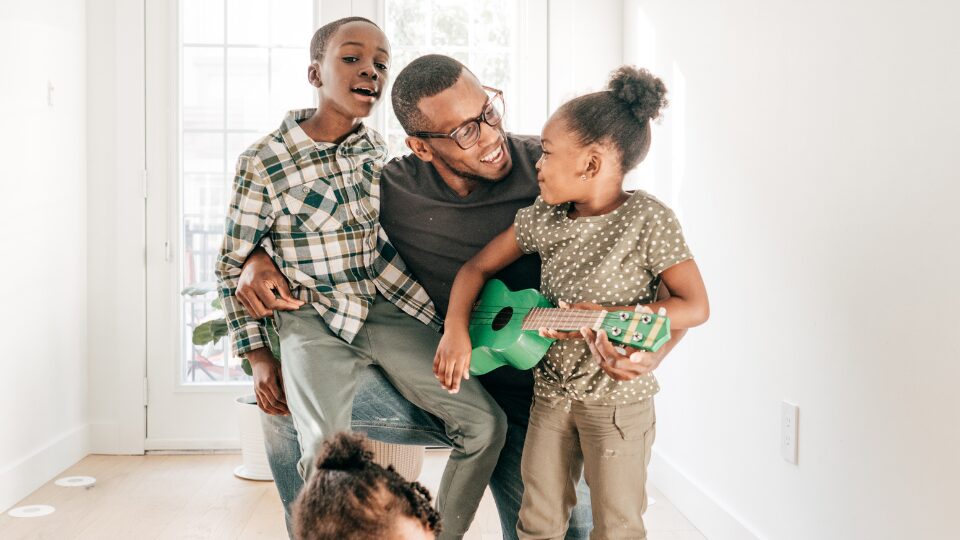
Singing when doing every day tasks, gives the task a little bit more excitement and it also helps develop routines. When my daughter was small I used to sing the "lets go and brush our teeth song."
This musical masterpiece went "lets go and brush our teeth, lets go and brush our teeth, to make them shiny" (sang to the tune of "lets go fly a kite" from Mary Poppins). This song REALLY helped me get through some tough mornings! Those mornings when it would have been a firm "NO" from my sweet child! She started to recognise the song as time to brush her teeth and it took away any frustration with it. It created a fun, positive atmosphere, she learned the song through repetition and it distracted her from not wanting to brush her teeth.
I mentioned this approach to one of the dads in my groups and he decided to make a song for him and his daughter to sing when they drop off mummy at work. This had previously been a heart wrenching experience for the child. But with the new song, it became fun and exciting as they could sing and laugh together when they were dropping mummy off.
Dancing, Jumping, walking, hopping, waving, clapping... the movement list is never ending!!
What I have found, is that we can often misjudge the importance of simple activities and the benefits they have. We often think we need to do some massive grand gesture when it comes to movement. Buy loads of interesting toys and instruments, when in fact a pair of socks to wave in the air is a great thing for kids. Some dads feel that mums seem to know how to create "All Singing and Dancing" routines (in literal terms too). In reality, we don't! And we can feel silly and self-conscious as much as men. But, when you see the joy on your little one's face you can get swept up in the fun they're experiencing. Try to put aside how you feel, and focus on them... it might help!
One great way to encourage movement is to move around like animals. You can stretch your arms high like giraffe, prowl gracefully on all fours like a cat or move very quickly like a leopard. By adding animal sounds you are not only teaching them the sound that the animal makes, you are also expanding their vocabulary and setting building blocks that will help them with their speech in the future.
If you decide to move to music, depending on your choice of tune, music and movement can be energetic exercise or an opportunity to create a nice bonding session for you both. Either way your child will be developing their motor skills, developing body and spatial awareness and also their vocabulary skills.
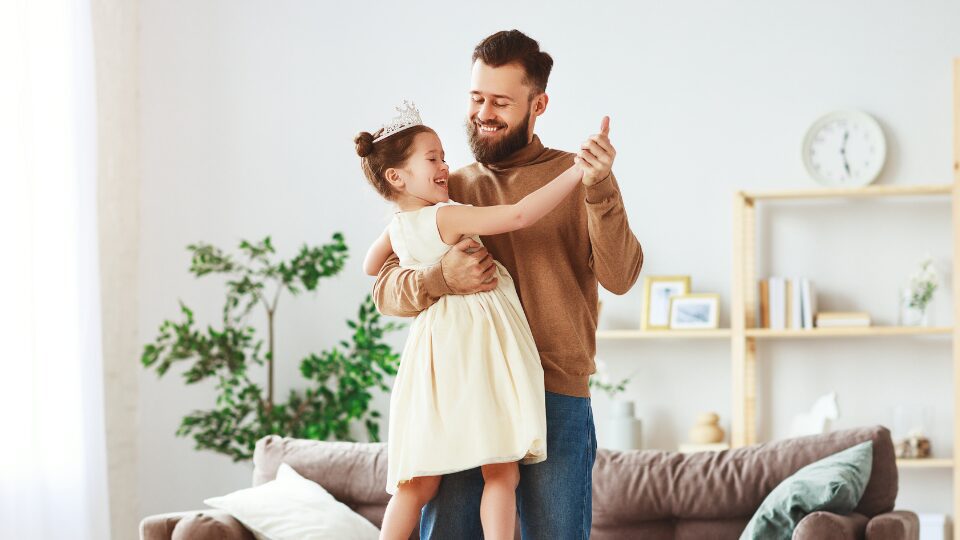
Why not have a little dance together? Simple games like "Musical Statues" encourage your child to listen and enhance their listening and turn taking skills. Or if your child is a bit older, ask them to listen for a word and give that word an action. For example, "jump every tome the word 'love' is said".
If it is a slower song, you can use this to create a calm, relaxing feeling. Maybe use this opportunity to move around like "slow snails" or even have a cuddle and a slower dance.
We have all heard baby/toddler sessions being referred to as "Mother and Baby groups". The truth is, after running Music and Movement sessions for more than 4 years now, I have found that lots of dads want to bring their children along to groups, but often they can't due to work commitments. Or, as said by one Dad, "I used to get nervous in case the baby started to cry and I had all the mums looking at me". Fewer groups are referring to themselves as "Mother and Baby groups" now. There is a greater understanding that society has changed and it is not just the mums who want to take their children to these groups. Plus there are more and more dad specific baby/toddler sessions popping up.
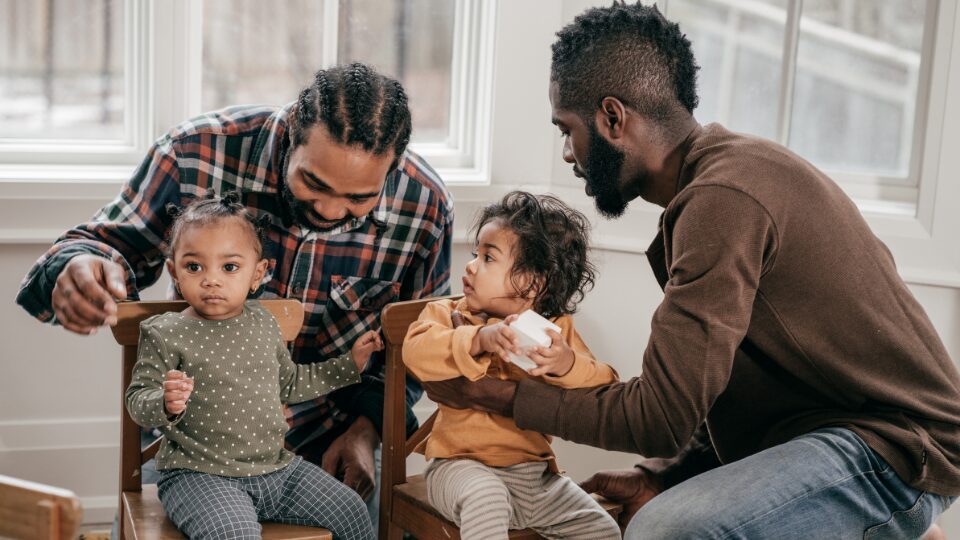
Music and Movement groups/toddler groups are a great way for dads to bond with their children. You will often find these sessions full of sensory props, instruments and other colouful eye catching things that you may not have at home. Because of that, it adds more entertainment and excitement to the group for your child.
Music and Movement groups can help with the development of social skills - a really important skill children need as they grow. They help children to participate in group work (eg working together using a parachute) and help grow confidence. Dads will get the opportunity to join in with songs and activities. And because there is usually a "leader" of the group, there is structure. This allows everyone to feel like they know what they are doing- taking the pressure away from parents and giving some inspiration for games at home.
For smaller babies, these groups are a great way for Dads to bond with their babies as they often focus on a lot of 1-1 time, listening to slow calm music and really creating a relaxing nurturing environment.
Overall, Music and Movement is a great way for Dads to be able to create a special bond with their children. As well as enhancing some of the key development points like social skills, speech and coordination. It is a fantastic way for Dads to build a unique, healthy bond with their children. For the Dads they are teaching their children skills and qualities to last a life time. For the children, they are learning and developing without really knowing... all while having fun... with Dad.
If you enjoyed this post and want more ideas of things to do with your kids, we have great blogs on Why It's Important for Dads to Play With Their Kids More, the importance of Outdoor Play, and a great Dad Chats Live with lots of Great Ideas For Indoor Play. You should definitely check them out!
After the impact of the pandemic on students, it is more important than ever for parents to find ways to support education.
According to a study by The Fatherhood Institute, during Spring 2020 (during lockdown) 78% of fathers spent more time with their children and 68% spent more time than usual on home-schooling and helping with homework.
Research* also shows that involved fathers can significantly improve the progress of their child’s education. To help give your child the best start in life, Ian Thompson, a father of two and a Maths tutor at Tutorful, the experts in online tutoring, gives his top tips of how dads can support their child’s education:
New research reveals that 78% of secondary school parents feel the pandemic harmed their children's education. With parents believing that their child is a whole school year behind (9.5 months). Online tutoring platforms like Tutorful has over 11,000 tutors to choose from. Parents can choose one to help gain back lost time, and support education.
The benefits of using online tutors include:
You have to find the tutor that suits your child best. With relevant experience and the personality that works with them. Sometimes when I teach we spend the first lesson just getting to know a little bit about their school experience. However, in many instances, just a few lessons can give a young person back their confidence. For me, as a tutor, that is a life changing event.
Asking your child to teach you about a subject can help you test them in a more creative way. They can choose a topic that they have recently learned about in school. Any questions they are not sure about you can find out together. Get them to help you search online or by reading a relevant book. Allow your child to have fun as the role of the teacher. You could get them a whiteboard and pens. Let them set the rules - make it fun!

Discussing classwork outside of the school environment will immediately give you an informal insight into what they are learning. The amount of homework set and what subjects they find difficult. Give your son or daughter plenty of time to show you what they can do. Remember, things have changed a lot since we went to school and kids are taught in different ways not! So don't be too quick to say that's not the right method. This can also be a great tool for revision. Teaching someone else will help them remember everything they've learnt, and can work better than re-reading notes for some kids.
An adventurous way to learn is through educational games that can help children with non-cognitive and cognitive skills. Whether it’s an entertainment video game, or games that teach skills like coding. Game based learning often motivates children as there is a competitive element.They can help with grammar, new concepts and building knowledge.
Take your child to the theatre, art exhibitions or workshops to teach them that learning is not limited to the classroom. There are lots of free events that you can find on platforms like EventBrite. For example, if they are a history buff, take them to a museum or archaeological site. Exposing children to activities outside of their school curriculum can help them discover passions and talents that they might never have known otherwise. The trips contribute to a well-rounded educational experience. They encourage children to use their imagination and help them express their feelings and opinions with you as their sounding board.
Ahead of exams - sitting in a bedroom, surrounded by the same four walls, isn’t always the best place to revise. The good news is that revision doesn't have to be boring! And bad days do not have to correlate with GCSE revision.
Why not offer to take your child to a cool cafe or coffee house? Grab a hot drink, log into the wifi and start studying! Something as simple as a change of setting can be great for the brain. A change of setting can be great for the brain. Often it motivates us to explore new ways to achieve our goals. Letting your teen choose where to go will be empowering. Which will help them to feel like they’re completely in control of their success.
The chances are, they’ll also see adults working with their laptops too. Sending a hugely important message that hard work is something that we choose to do, to achieve success throughout our lives.
Not a fan of a coffee shop? If the weather is good, why not try a park? Or a finding a quiet, pretty spot in the country side? Fresh air, and a change of scenery can be great for learning.
If your child has been working hard on a subject (even if they are struggling with it) make sure you acknowledge their efforts. Children, whatever their age, want to feel seen by their parents and acknowledgments show you care.
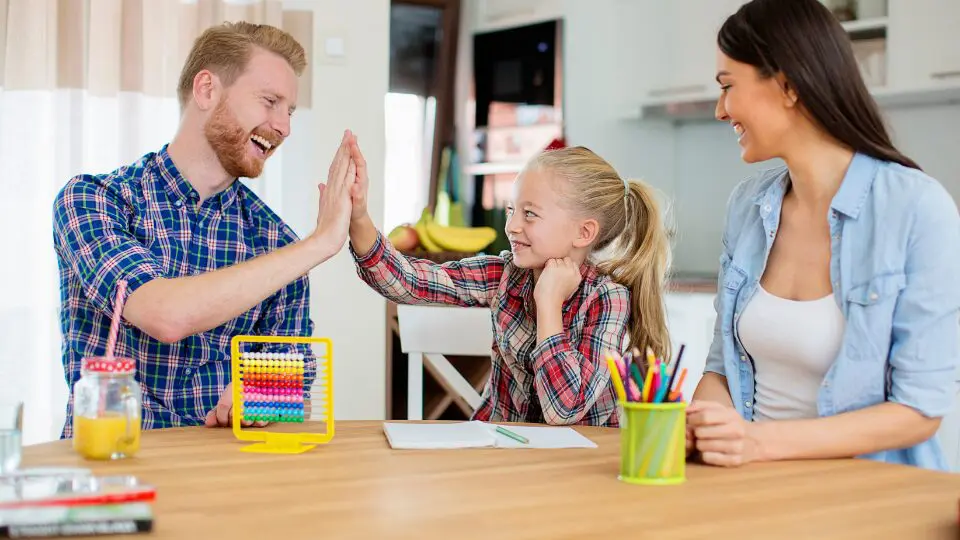
Although children need to pass exams to progress in education. Remind them that character traits like determination, resilience and perseverance aren't counted in tests! These are all signs of success that aren't measured by the exams they take. And will also help them longer term when they reach the workforce.
If you think your child needs positive reinforcement, a reward can be as simple as cooking their favourite dinner. Or watching a movie, allowing more screen time, or maybe a small token gift? But don't forget, simply saying words like "I'm proud of you" is a great reward for a child. And these can be morale boosters to help them stay positive.
There are certain life skills that can help your child develop that can be taught from an early age. From learning the basics of cooking e.g. how long to cook an egg and pasta; to gardening like growing your own food and herbs. Also teaching them about local wildlife or doing the laundry. And as they get older understanding the cost of living like a loaf of bread, milk, bills etc. This can help prepare children for when they move out or go to university. And it will help them feel better prepared to set them up for success.
I wasn't always a teacher and didn’t expect at 18 years old that one day I would become one! However, somebody in education gave me a chance and realised I had the Math knowledge and the ability. The only thing lacking was confidence.
I owe a huge thank you to my friend Paul. One day he gave me a whiteboard pen as I walked into a room. Then he said that he had an appointment to go to. He threw me in the deep-end, and left me in a room to teach 20+ students. The rest, as they say, is history.
It took me a while to find what I wanted to do, and be. But, I did and I love it. An important part of being a teacher, is remembering that not all children will learn at the same pace. Or in the same way. The most important way to support education, is to give your child space to shine.
Are you looking for more ways to support education? Or maybe you want to learn about Great Ways For Dads To Connect Through Educational Support? Maybe your little ones are transitioning to school or nursery and you're starting the formal education journey?
Whatever you're looking for, we have some really great information about education across the site. From more great blog posts, to brilliant Dad Chats about Education.
Mental health is a subject that has always been close to my heart. Having suffered with my own mental health for a number of years, and watching the people I love experience their own difficulties, it is a topic I will always try to talk about. Today is World Mental Health Day. I want to use this day to share my story. Hopefully, it will help others realise they aren't alone.
I always remember growing up and feeling that there was something wrong with me. As a young child I had been described as naughty. In fact. I later found out that my primary school teachers had nicknamed me "hell on legs". Then throughout the rest of school I tried to blend into the background.
I didn't want to bring attention to that fact that I was petrified of my own mind. And terrified of what I might end up doing. I was an angry child. But I was also very scared. As an adult I can name these emotions, but as a child I couldn't understand what they were. Nor did I know that they were a reaction to trauma in my life. I was so scared of hurting other people with my words or actions that I started hurting myself. I was picking and scratching at my skin from a young age, and started self-harming at 12. It was the only way I could find to cope at that time.
It wasn't until I spoke out and got the help I needed at 19 that I realised I wasn't overreacting or being dramatic. I wasn't a problem child or invisible. I was mentally ill. and reacting to trauma. What I needed was support, not being labelled "hell on legs"!
Over the next 3 years I tried different therapies and medications. To be honest that can be tricky, and is a bit of an experiment for everyone. It took a little while but I finally found a mix that worked for me. I was making progress. I then experienced a relationship breakdown. Moved 6 hours away from family and friends, and ended up finding out I was pregnant. The medication I was on wasn't suitable to take throughout pregnancy, so I stopped taking them. This meant that I had to find a new way to handle the voices that were wedged deep within my brain. But now that I knew I was going to have this little baby relying on me. I couldn't allow myself to fall back into the same routine and patterns.
I found pregnancy a rough old ride. Then the birth was incredibly traumatic. It wasn't until Grayson was around a year old that I finally accepted that his birth had traumatised me and I had probably experienced some form of postnatal depression. However, rather than do anything about it I felt I had to just push on through. I was doing my best for my son and husband, but I didn't get support. I felt like had to make myself get better. To be strong and in my mind at the time this was by ignoring the problem. Now I know that this was wrong.
I think a lot of people can probably agree that growing up our parents were a pillar of strength. They were never ill. Never seemed to take time off unless it was for something that could not be ignored. The only memory I have of my own mum being ill as a child is when she got Pneumonia. So when we become parents ourselves, it feels as though we have to be invincible for our own children.
There in lies the problem, because no one is invincible. I had hoped when I had my son that my mental health issues would magically melt away. Then I could be this perfect parent that was always happy and well. I now know that isn't normal or healthy. Just because I had this new baby in my life, didn't mean the depressive episodes stopped. It didn't mean that constant pit of anxiety in my stomach had gone and it didn't mean that the intrusive thoughts suddenly stopped. I still had a chemical imbalance within my brain.
I was still me, and I still had issues with my mental health. That would not disappear just because I was now someone's mum.
We have all experienced that extreme sense of parental guilt when we snap at our children. You know the ones, where you're short tempered because we've had one of "those days". Or we stick them in front of the telly because we just need some time to ourselves. But in reality, these are not moments that our children are going to remember when they grow up. And we are still entitled to moments of self care as parents. If we want our kids to grow up and feel comfortable enough to be honest with their feelings, then this is a behaviour they need to learn from us.
Showing your emotions is not a sign of weakness. Although it may feel uncomfortable at times, it is something we all need to try to do.
I will have days where you the depression is too overwhelming that I struggle to function, and rather than completely hide it or push through, I tell Grayson that I'm feeling sad and I don't really know why. I reassure him that I'll be okay, but that I just feel a bit sad. He gives me a hug. Tells me it will be okay. That I can talk to him about it. Then goes about his day as any normal 3 year old should. Obviously there is more to it than just feeling sad. But it's about explaining in simpler terms depending on the age of the child.
By doing this small act, Grayson will come to Mark and I when he's feeling sad or angry or any other emotion and tell us. He may not always be able to explain why he feels it, but he is comfortable enough to tell us and we can try to offer him comfort and reassurance. We are normalising difficult emotions so that he doesn't feel scared of his own mind like I did.
There are still times when I can see the anxiety I know all too well showing itself within him. Or the struggle to diffuse the anger that is rising within his chest. I feel like I am looking at a mirror image of myself. The pain that makes me feel can often bring me to tears. But rather than try to ignore how he's feeling or distract from it, I will embrace his feelings. I give him what I needed growing up. I feel by doing this he is still going to be experience negative emotions - because every human does. But hopefully he will have the appropriate tools to handle them as he grows.
When we become parents, we do not become super humans that are incapable of negative feelings and pain. We need to be more kind with ourselves, because we are only human. You can still be a good parent, and battle your mental health.
I am a mum, a wife, a daughter, a sister and a friend - but I am still Ashleigh. I am still battling my mental health every single day. Regardless of who you are and the titles you hold, you are allowed to struggle.. You are allowed to have issues with your mental health. It is about finding the right coping mechanisms that work for you.
I've accepted the likelihood that I will live with these mental health issues for the rest of my life. I am likely to be in therapy and on and off medication for as long as I need it. However, this doesn't upset me or make me angry. It doesn't make me a failure, or weak. It makes me incredibly strong, because there is no weakness in admitting that you need help.
If you feel that you are struggling, or you don't feel yourself and you haven't in a while, then please find someone to talk to. If you don't feel comfortable talking to a professional start by talking to someone you trust. Failing that, write everything out in an email to yourself or a letter. When you read it back - pretend someone you love has written it and what you would tell them to do. Once you're able to, please reach out to professionals.
But above everything else, please remember to be kind to yourself - because you are strong and you are doing the best you can.
Happy World Mental Health Day.
If you need some help with your own mental well-being, there is so much great support available to you. To find support in your local area visit Hub of Hope, enter your postcode. Or you can contact the Samaritans anytime for mental health support.
Or you can visit Mental Health Foundation - the creators of World Mental Health Day for more great resources.
To mark World Mental Health Day, we had a great mental health open mic night over on the Dad Chats on Friday. We heard from our community about the importance of talking about our mental health. Head over to watch it.
Dad Chats Live - Equal Parental Leave. Today we were joined by Rob Simpson who works for @avivauk. Aviva have scrapped paternity leave, two weeks just aren't enough - Aviva recognised this and have an excellent new policy.
At Aviva all staff are entitled to equal parental leave when they have a child. This means that fathers can take up to 6 months paid leave and up to 12 months including unpaid leave. This is a game changer when becoming a parent and listening to Robs experience it’s easy to see why. Rob tells us why this policy was so important for him, his wife, and his new born baby - especially getting through those first few weeks of sleepless nights! He also tells us how supportive Aviva were when he used the policy, not only do they actively encourage their staff to make use of the policy. They also keep in touch with their staff while they're off. Rob's manager kept him up to date with things at work so he didn't have to worry about it!
This policy is an absolute game changer, and something we think is so important for dads to be offered. We would love to see more companies making a change to support equal parental leave.
Aviva have also written us a great blog post telling us all about their policy. It's entitled How Aviva Are Changing Paternity Leave For The Better. Anthony Fitzpatrick Head of colleague Experience and Employment Policy at Aviva tells us about the change to the entitlement, and Rob shared more of his experiences of using it.
Dad Chats Live - talking about the benefits of outdoor play on our children’s development, health and well-being!
With special guest Helen Stroudley from @peeplecentre
The brilliant Helen Stroudley joined Nigel to talk about why playing outdoors is so important! It has a great positive impact on our health and happiness - and does the same for our children. Whether you just get out for a walk or plan a full outside day - Helen tells us why we need to make the most of being outdoors.
Helen also tells us how to be best prepared for getting outdoors, so that there is no stress when we're there. From simply packing extra clothes, to wearing wellies for jumping in puddles! We know our children love to get outside, but hearing an expert tell us why it is so good for us all was a really brilliant chat - Thanks Helen!
Helen has also written us a brilliant blog Why Outdoor Play is Great for Your Health and Happiness She shares some great ideas for things to do with your kids to get the benefits of outdoor play. and answers the following questions
Make sure you check it out!
Plus if you want to know Why it’s important for dads to play with their kids more Susie Robbins joined us on another Dad Chat and wrote us a blog post answering the following.
